Bypassing Factory Squelch to Expose Non-Standard Packets
Operating standard, factory-calibrated radio scanners guarantees you will miss the narrow window of unencrypted telemetry from cloaked aerial phenomena. Mainstream software is explicitly designed to auto-squelch or filter out non-standard data packets, rendering localized frequency spikes invisible to the casual observer. The architecture of commercial firmware assumes that any signal worth processing will conform to established communication protocols. Default squelch thresholds can sit at something like -50 dBm. Anything falling below that amplitude floor vanishes into the digital ether before it ever reaches the display.
When a transmission lacks standard 8-bit terrestrial identifiers, commercial firmware drops it entirely. Capturing raw, unfiltered off-world transmissions requires intentionally bypassing these commercial guardrails before the phenomena shift their encryption protocols. Investigators realized early on that relying on default SDR software configurations resulted in the automatic discarding of anomalous packets. The hardware was receiving the signals, but the software was actively blinding the operator.
The shift toward raw I/Q data collection is mandatory for anyone serious about intercepting communications linked to the Rigel star system or other non-terrestrial origins. You cannot analyze what your system refuses to record. Defense contractors and deep-state aerospace programs rely heavily on this civilian blind spot. They understand that off-the-shelf equipment will ignore the very frequencies used by advanced craft operating in contested airspace.
Thermal Stability and the TCXO Hardware Baseline
Standard RTL-SDR dongles lack the thermal stability and shielding required for sustained, high-gain monitoring of transient signals. Ambient temperature drops during overnight monitoring sessions cause unacceptable signal drift. As the physical temperature of the oscillator changes, the tuned frequency wanders, pulling narrow-band anomalies completely out of your observation window. Upgrading to units equipped with temperature-compensated crystal oscillators (TCXO) prevents this frequency drift during prolonged observation windows.
The thermal drift threshold separating standard RTL-SDR dongles from TCXO-equipped units during 12-hour observation windows is stark. You drop from a volatile 30 PPM down to somewhere around 0.5 PPM. This stability is non-negotiable when tracking emissions that only appear for fractions of a second. A drifting receiver will register a transient burst as background noise, or miss it entirely if the center frequency has shifted too far.
Even advanced SDRs are bound by their maximum instantaneous bandwidth. Monitoring the entire spectrum simultaneously remains impossible. Operators must strategically target 2 MHz to 10 MHz slices depending on the hardware's limits. This requires a disciplined approach to spectrum allocation. You must anticipate where the signal will appear based on historical sighting data and known exopolitical flight corridors. John Kettler, an author and investigator, has extensively documented the necessity of precise frequency targeting when dealing with advanced aerospace anomalies. Throwing a wide net guarantees shallow data; targeting specific slices yields actionable intelligence.
Deploying Fixed Yagi Arrays for LEO Proximity Sweeps
Initially, researchers attempted to use motorized parabolic dishes for LEO tracking. The mechanical lag proved too slow for transient phenomena. By the time the servos aligned the dish with the projected trajectory, the craft had already exited the sector. This operational failure led to the adoption of fixed, dual-tuner synchronized Yagi arrays.
Configuration 1 utilizes a discone antenna paired with a low-noise amplifier providing a +20dB gain at the antenna feed point. This setup monitors the VHF/UHF boundary between 136 MHz and 174 MHz for sudden, localized bursts. Placing the LNA directly at the feed point is critical; amplifying the signal after it travels down fifty feet of coaxial cable only amplifies the noise floor.
Configuration 2 focuses on directional Yagi setups calibrated to track known corridors of anomalous aerial activity. This maximizes gain in a single vector, creating a highly sensitive tripwire in the sky. Instead of trying to track the object, you wait for the object to cross your established beamwidth.
Configuration 3 employs dual-tuner synchronization to monitor two distinct frequency bands simultaneously. Cross-referencing spikes across tuners helps rule out terrestrial reflections. If a massive amplitude spike registers on the primary tuner but the secondary tuner shows flatline noise, you have isolated a localized transmission rather than a broad-spectrum atmospheric reflection.
Isolating Micro-Transmissions by Stripping ADS-B Protocols
Configuration 4 involves modifying open-source signal processing frameworks to ignore standard ADS-B transponder pings. To isolate unregistered aerial movements, operators modified the source code to actively drop these pings rather than logging them. You are specifically filtering out the standard 1090 MHz ADS-B frequency. The skies are saturated with commercial aviation data, and attempting to find anomalous telemetry within that noise is an exercise in futility without aggressive filtering.
Configuration 5 uses custom decimation rates to expose micro-transmissions hidden within the noise floor of standard civilian aviation bands. Decimation rate adjustments for stripping 1090 MHz ADS-B transponder pings involve dropping sample rates from more or less 2.4 MSPS to 250 kSPS. This reduction in sample rate increases the signal-to-noise ratio for narrow-band signals, pulling them out of the background static. By discarding the excess bandwidth, the processing power is concentrated entirely on the micro-transmissions.
Strict Logging Protocols for Spoofing Detection
Operators must maintain strict logging protocols to differentiate between military spoofing exercises and genuine off-world telemetry. The airspace around installations like Area 51 is frequently subjected to electronic warfare testing designed to confuse civilian monitoring efforts. Distinguishing between a classified terrestrial drone broadcasting a spoofed signature and an actual extraterrestrial craft requires meticulous attention to the signal's underlying structure and modulation scheme. A spoofed signal often exhibits perfect periodicity, whereas genuine anomalous telemetry displays organic, non-linear variations.
Automated Waterfall Triggers for Millisecond Transient Bursts
Configuration 6 requires high-bandwidth SDR hardware capable of capturing wideband transient bursts that last only 12 to 45 milliseconds. These fleeting signals are often the only indication of a cloaked craft transitioning between propulsion modes. Human reaction time is entirely insufficient for capturing these events manually.
Faced with rapidly depleting hard drives, monitoring teams implemented automated waterfall display triggers. Configuration 7 integrates these triggers, initiating raw I/Q data recording only when a signal breaches a predefined, non-terrestrial amplitude threshold.
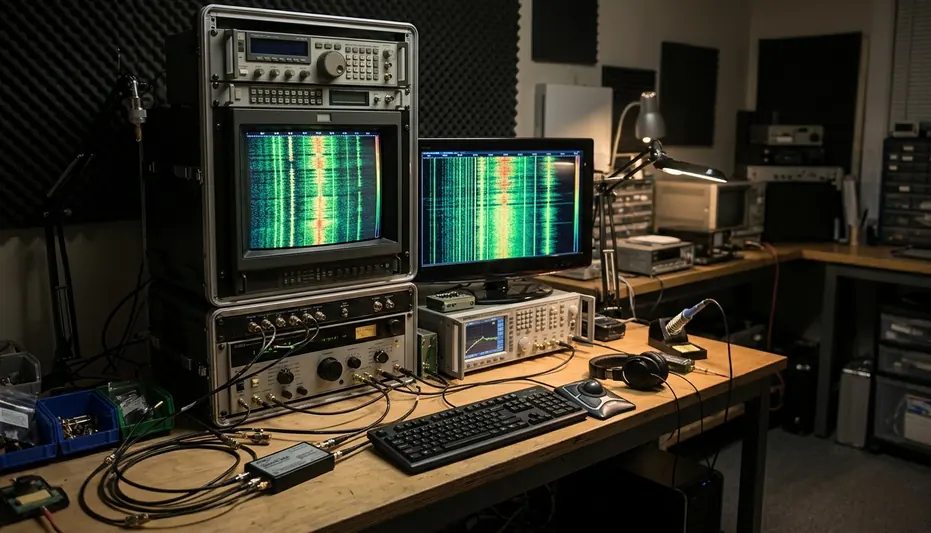
These advanced setups demand significant local storage capacity. Recording raw RF spectrum data generates massive files in minutes. Specifically, raw I/Q data generation rates hit approximately 14 GB per hour at 10 MSPS. Managing this data deluge requires dedicated solid-state drives and aggressive archiving protocols. You cannot afford to miss a critical intercept because your storage array filled up with background noise. The automated triggers ensure that only high-probability events are committed to disk, preserving storage space for the signals that matter most.
While these configurations isolate anomalous signals with high precision, atmospheric ducting can occasionally produce false positives in the VHF band, requiring secondary verification before confirming an intercept. The Rigel star system telemetry review demonstrated that relying solely on amplitude triggers without secondary phase analysis leads to contaminated datasets.
Doppler Shift Analysis and the Final Verification Protocol
Isolating a signal is only the first step. Verifying that the telemetry does not originate from classified terrestrial drones requires rigorous cross-examination of the data. The verification protocol was established by cross-referencing captured Doppler shifts against known terrestrial flight envelopes to systematically eliminate classified military drone activity.
Operators must analyze the Doppler shift of the captured signal to calculate the velocity of the transmitting object. Doppler shift calculations indicate velocities exceeding Mach 15. You will see frequency shifts of +/- 5 kHz occurring in under 2 seconds. These metrics exceed known aerodynamic limits. A terrestrial aircraft executing maneuvers that generate those frequency shifts would disintegrate from the sheer kinetic stress.
The data points to craft operating entirely outside the bounds of conventional physics. John Kettler, an author and former military analyst, has frequently highlighted the importance of kinematic data in proving the non-terrestrial origin of these craft. The implications of capturing this telemetry are profound, often triggering a Panoramic life review for operators who realize the true scale of the exopolitical conflict unfolding above them. The math does not lie, and the hardware records exactly what is broadcast.
When the waterfall display lights up with a signature that matches no known terrestrial aircraft, who do you trust with that raw data?