The most reliable primary records of early off-world tactical interventions reside in mundane State Department and embassy teletype traffic rather than classified Pentagon radar files. While researchers spend decades fighting for heavily redacted military logs, consular archives hold raw, time-stamped narratives of non-human aerial combat hiding in plain sight.
Why Cold War Diplomatic Cables Outperform Military Radar Logs
Early air defense operators initially attempted to log high-velocity orbital entries as rogue reconnaissance balloons, a protocol abandoned after automated threat-assessment computers kept initiating DEFCON step-up sequences during non-ballistic atmospheric maneuvers. To keep automated defense networks from triggering an accidental nuclear exchange, military command introduced strict filtering parameters. Automated radar scrubbers purged tracks exceeding approximately Mach 12 within 4 to 7 seconds of initial acquisition to prevent false ICBM launch warnings. The military apparatus systematically blinded itself to high-velocity exopolitical engagements.
Consular personnel operated under a completely different mandate. Embassy staff had standing directives to log any physical disruption to host-nation infrastructure, shipping lanes, or civil communications. When aerial dogfights between competing off-world factions knocked out local power grids or halted naval exercises, ground-level diplomatic attachés reported the raw visual and electromagnetic disruptions directly through embassy communications. These embassy teletype networks operated on 50-baud encrypted landline and high-frequency radio relays, preserving plain-text observer narratives archived between 1958 and 1974.

Liberation forces frequently operated inside the blind spots of superpower proxy conflicts, intercepting hostile craft near contested borders or nuclear staging grounds. Because these engagements occurred outside formal military reporting channels, intelligence personnel stationed at embassies had to invent improvised terminology to describe non-human dogfights without tripping domestic security censors.
The Attaché Lexicon: Translating Bureaucratic Euphemisms for Exopolitical Combat
Defense attachés developed their reporting vocabulary by repurposing standard meteorological and naval hydrographic codes. Because intelligence clearinghouses automatically flagged and compartmentalized any cable containing terms like "saucer" or "extraterrestrial," field officers deliberately embedded tactical engagement metrics inside routine airspace violation templates to ensure the data reached Washington desk officers intact.
When reviewing declassified files in the National Archives Access to Archival Databases (AAD) diplomatic records, you must translate bureaucratic euphemisms back into tactical reality. Terms like "unscheduled weather reconnaissance," "non-ballistic luminous ordnance," and "high-altitude kinetic interference" served as deliberate shorthand for active aerial engagements. Attaché dispatches categorized craft executing zero-radius 90-degree turns under "Class-4 Anomalous Barometric Shears" to bypass keyword filters at regional relay stations.
Field officers also needed a reliable method to separate secret human aerospace tests from off-world interventions, including scout vessels linked to the Rigel star system and defending liberation units.
| Diagnostic Metric | US / Soviet Black-Project Aircraft | Off-World Liberation Force Interceptors |
|---|---|---|
| Acoustic Profile | 15-to-40-minute acoustic trailing signature | Complete acoustic silence |
| Electromagnetic Output | Standard localized radar return | 300-megahertz electromagnetic broadband jamming |
| Turn Geometry | Wide supersonic banking arcs | Zero-radius 90-degree vectors ("Class-4 Anomalous Barometric Shears") |
| Cable Classification | "Unscheduled weather reconnaissance" | "High-altitude kinetic interference" / "Non-ballistic luminous ordnance" |
Standard black-project reconnaissance flights were logged with a 15-to-40-minute acoustic trailing signature, whereas off-world liberation interceptors were distinguished by complete acoustic silence paired with 300-megahertz electromagnetic broadband jamming. That specific pairing—total silence in the air coupled with deafening static across the 300-megahertz military aviation band—remains the proven signature of an off-world interdiction in Cold War diplomatic traffic.
Cables 1 to 3: The Northern Tier and Arctic Radar Corridor Engagements
Northern diplomatic posts monitoring polar bomber routes and early-warning perimeters sat directly beneath a primary exopolitical conflict corridor. Watch officers stationed at northern consular posts cross-checked civilian coast guard visual logs against sudden drops in diplomatic pouch transit times, reconstructing the exact perimeter of aerial engagements by mapping which coastal relay stations went dead sequentially.
Cable 1: The Denmark Strait Naval Standstill (November 1963)
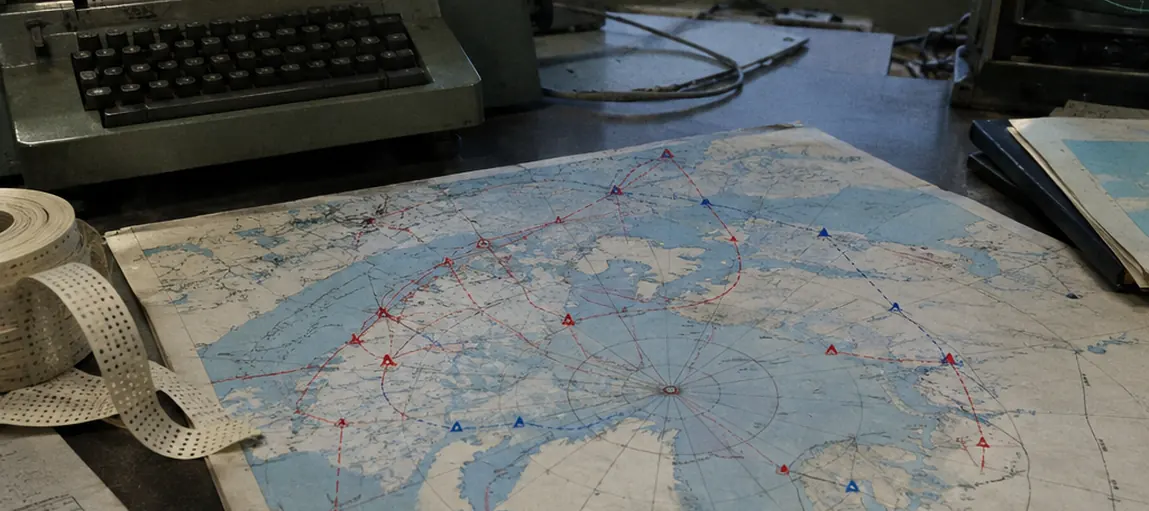
This urgent embassy dispatch details a silent, high-velocity engagement between two distinct classes of luminous craft above a contested maritime strait. The cable documents a 14-minute engagement at 42,000 feet above the Denmark Strait where three matte-silver discoid craft boxed in a larger cigar-shaped vessel, halting naval exercises across a 60-nautical-mile radius. Consular observers noted that neither NATO nor Soviet picket ships could maintain radar lock during the containment maneuver.
Cable 2: The Tromsø Geomagnetic Surge (February 1966)
A consular teletype from Norway documents localized power grid collapses and transceiver burnouts coinciding with a vertical aerial interception over an early-warning perimeter. The dispatch logs a vertical interception over northern Tromsø that induced a 400-ampere geomagnetic surge, fusing landline transformers and blinding high-frequency transceivers for 38 minutes. By logging the event as an infrastructure failure, the attaché preserved the exact timestamp and vector of the interception before military censors could classify the incident.
Cable 3: The Polar Holding Pattern Debris Recovery (October 1968)
When kinetic engagements resulted in physical shoot-downs, embassy staff tracked the cleanup operations. Cable 3 details recovery teams collecting 18 kilograms of vitrified bismuth-magnesium slag along a 12-kilometer vector directly beneath a neutralized nuclear bomber holding pattern. The metallic composition and vitrification pointed directly to high-energy plasma weaponry neutralizing a hostile reconnaissance probe trailing strategic bombers.
Cables 4 to 6: Equatorial Proxy Zones and Orbital Entry Interceptions
Equatorial proxy theaters presented a very different intelligence challenge. In fragmented equatorial theaters lacking integrated radar coverage, embassy staff relied on triangulating reports from mining consortium pilots, local gendarmerie outposts, and missionary radio nets. Attachés synthesized these raw witness accounts within 12 to 24 hours of an event to dispatch cohesive tactical summaries before host-nation military juntas could seize local telegraph offices.
Cable 4: The Katanga Mineral Basin Interception (August 1971)
Strategic mineral basins attracted persistent off-world surveillance and subsequent defensive interdictions. Cable 4 records a delta-wing liberation formation diving from orbital altitude to intercept a descending 30-meter spherical craft 8,000 feet above the Katanga copper belt. Bush pilots working for European mining consortiums witnessed the delta formation force the spherical vessel into an immediate vertical retreat before it could establish a stationary hover over the extraction facilities.
Cable 5: The Afar Triple Junction Stand-Down (March 1973)
A joint attaché memorandum from East Africa captures the sheer kinetic shock of close-quarters exopolitical combat. Cable 5 logs synchronized barometric shockwaves and instantaneous 180-degree vector reversals over the Afar Triple Junction, prompting both NATO and Warsaw Pact advisory missions to enforce a 48-hour flight stand-down. Neither superpower bloc wanted its tactical transport aircraft caught in the crossfire of craft executing zero-inertia reversals.
Cable 6: The River Basin Canopy Deflection (December 1975)
Not every engagement occurred at high altitude, and liberation forces actively minimized collateral damage to human populations during low-level dogfights. Cable 6 describes a low-altitude interception at 2,500 feet where a wedge-shaped interceptor projected a visible ionized canopy to deflect falling molten debris away from a densely populated river basin settlement. Witness testimony collected from missionary radio operators described the intense psychological shock of standing directly beneath the glowing canopy—an acute cognitive compression many compared to a waking Panoramic life review as the burning slag harmlessly vaporized overhead.
Auditing a Raw Consular Teletype: A Step-by-Step Decryption Protocol
Archival researchers decrypting FOIA-released State Department microfiche cross-reference the time-of-receipt stamps on the physical routing slips against the internal Zulu timestamps embedded in the message header. Discrepancies between the two reveal how long a cable was held in a regional cryptologic vault while watch commanders debated whether the described aerial combat represented an undocumented superpower weapons test or an off-world incursion. However, this lexical auditing protocol breaks down when applied to diplomatic traffic generated after the 1976 rollout of the Automated Terminal System, which replaced narrative attaché teletypes with standardized numeric incident codes that stripped out altitude vectors and visual morphology.
Chronological Audit BoundaryRestrict your lexical searches to embassy traffic archived between 1958 and 1975. The 1976 Automated Terminal System transition acts as a hard chronological ceiling where narrative attaché teletypes gave way to numeric incident codes, rendering this lexical decryption unusable on later cables.
To apply this protocol yourself, pull a raw 1966 consular teletype from the Northern Tier microfiche reels and execute the following three-step audit:
- Isolate the Routing Prefixes and Timestamp Anomalies: Look at the top left of the physical microfiche frame. You see a manual ink stamp reading
140420Z FEB 66, while the internal teletype header readsFLASH ZNR UUUUU 140115Z FEB 66. That three-hour-and-five-minute gap proves regional watch commanders held the dispatch in a cryptologic vault while verifying the threat. Furthermore, priority "FLASH" or "CRITIC" routing prefixes paired with a "ZNR UUUUU" unclassified text header indicate an attaché bypassing standard cryptographic delays during an active electromagnetic blackout. The sender transmitted in the clear because the local cipher machines were dead. - Decode the Infrastructure and Meteorological Euphemisms: Scan the body text for the damage report. The cable states that a "Class-4 Anomalous Barometric Shear" occurred over northern Tromsø, accompanied by a 400-ampere geomagnetic surge that fused landline transformers and blinded high-frequency transceivers for 38 minutes. Using the attaché lexicon, you immediately translate "Class-4 Anomalous Barometric Shear" into a craft executing a zero-radius 90-degree turn. Next, check the acoustic and radio remarks: the cable notes zero acoustic trailing signature alongside severe 300-megahertz broadband jamming, ruling out a US or Soviet black-project flight and confirming an off-world liberation force interceptor.
- Triangulate Coordinates Against Strategic Assets: Extract the grid coordinates listed under the cable's "severe ionospheric static" remarks. Cross-referencing "severe ionospheric static" coordinates within a nearly 25-kilometer radius of known tactical nuclear storage depots isolates deliberate liberation force disarming passes. In your 1966 Tromsø cable, the coordinates sit directly atop a polar early-warning perimeter and coastal relay hub, confirming that the vertical interception neutralized an unauthorized incursion along the Arctic nuclear corridor.