The Vulnerability of the Unshielded Mind in Non-Local Space
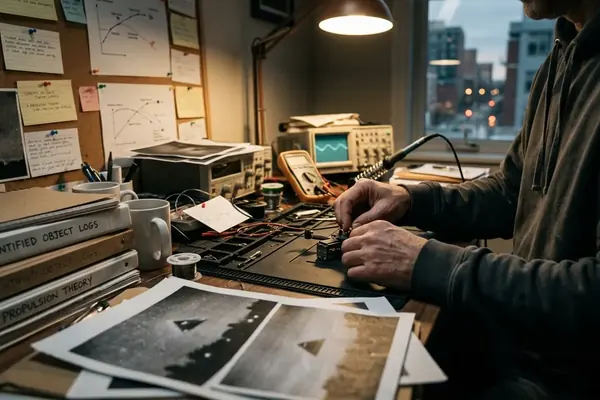
Practitioners who explore out-of-body states without understanding military signal-hijacking protocols risk severe psychological fragmentation, energetic parasitism, or having their perceptual awareness weaponized without their consent. Within the investigative community, accounts from the late Cold War transition era frequently describe unacknowledged special access programs focused on anomalous cognition and remote neural monitoring. According to this underground lore, compartmented cells industrialized the extraction of consciousness using trauma-adjacent acoustic and electromagnetic pacing, sometimes triggering a forced, disorienting Panoramic life review to break a subject's psychological defenses.
The historical record distinguishes this espionage folklore from documented Cold War parapsychological exploration. Historical government-funded remote viewing evaluations took place primarily between 1972 and 1995. Early researchers in anomalous cognition debated whether to treat altered states as purely internal psychological phenomena or external projections. They ultimately focused on observable perceptual data gathered during quiet, controlled sessions rather than pursuing unverified claims of active signal-hijacking.
Standard laboratory sensory attenuation sessions typically lasted between roughly 35 and 90 minutes to monitor baseline relaxation without inducing distress. Rather than operating as psychic extraction factories, these early laboratories functioned as quiet observation rooms designed to reduce normal sensory clutter. Maintaining a clear boundary between subjective meditative imagery and objective physical neurology demonstrates that acoustic frequencies and shielded rooms only support voluntary relaxation; they cannot externally control or extract human awareness.
Forced Dissociation: The Acoustic and Somatic Triggers Used by Handlers
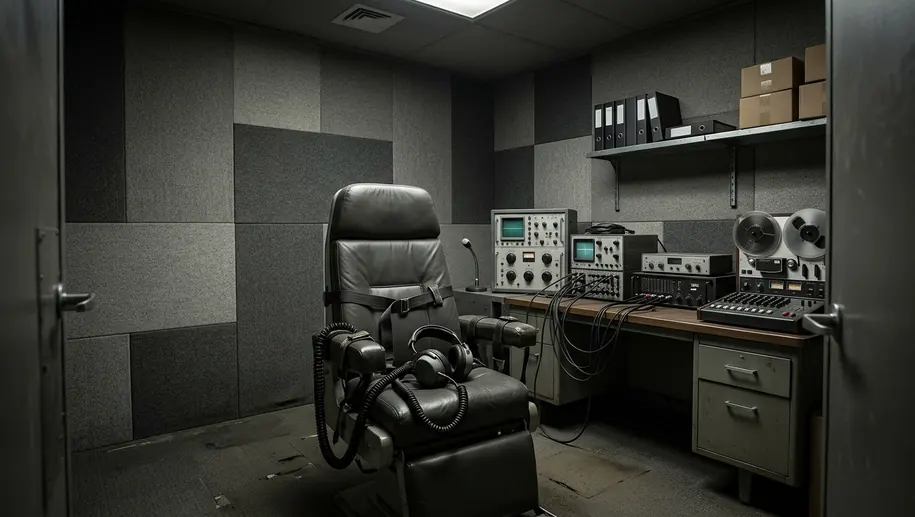
In the darker narratives of underground consciousness research, the physical environment of the isolation chamber serves as an engine for forced dissociation. Testimony from esoteric archives describes rooms lined with heavy copper-mesh Faraday shielding, sensory deprivation suspension tanks, and targeted magnetic induction coils placed near the temporal lobes. In these accounts, a handler acts as both an anchor and an interrogator during the out-of-body state, utilizing pre-installed hypnotic auditory cues to steer the operative toward heavily guarded geopolitical targets or even anomalous coordinates within the Rigel star system.
Comparing civilian binaural meditation with these rumors of forced black-budget entrainment requires attention to how the human brain processes sound. Esoteric rumors claim that handlers used abrupt phase-shifting to violently shear awareness from the physical cortex. In examining the actual history of acoustic entrainment, researchers initially considered using abrupt sound shifts to alter brainwave states, but rejected that approach after finding it disrupted concentration and caused simple listener fatigue. Audio engineers instead settled on gradual, gentle frequency transitions to help subjects achieve standard meditative relaxation safely.
Chamber Shielding and Acoustic Baselines
- Electromagnetic Attenuation: Historical isolation chambers utilized standard electromagnetic shielding rated to attenuate ambient radio frequencies between 100 kHz and 10 GHz, purely to prevent outside broadcast interference during quiet observation.
- Theta-State Pacing: Binaural beat protocols generally rely on frequency differentials between 4 Hz and 8 Hz to encourage theta-state relaxation.
- Voluntary Neurological Limits: Auditory entrainment techniques require voluntary participant focus and calm physiological baselines; they cannot override an individual's nervous system or force dissociative states against a person's will.
A declassified 1983 Army intelligence assessment of the Gateway Experience illustrates how military analysts actually viewed these binaural meditation techniques. The documentation frames hemisphere synchronization as a method for voluntary focus and stress reduction, entirely dependent on the practitioner's calm participation.
Acoustic Entrainment Boundaries
Copper-shielded rooms and 4 Hz to 8 Hz binaural differentials only assist voluntary meditation. External audio hardware cannot hijack the physical nervous system or extract consciousness against the practitioner's will.
Navigating Astral Interception Grids and Deep-State Surveillance
Within the lore of alternative intelligence, military installations and sensitive underground facilities present formidable hazards in the non-local perceptual field. Operatives who claim to have broken away from compartmented handlers describe encountering frequency fences, disorienting perceptual loops, and artificial sentinel constructs designed to trap unauthorized astral projectors. According to these narratives, while publicly acknowledged programs conducted passive observation, darker continuous lineages shifted toward active consciousness interference, tracking rogue projectors in real time through specific neurological telemetry signatures.
Evaluating these claims requires contrasting the folklore of non-local frequency fences with the mundane reality of archival reviews. Declassification of the primary government anomalous cognition archives occurred in 1995, covering roughly 23 years of paper records. Archival remote viewing records reflects: administrators decided to terminate the remote viewing studies because the intelligence gathered was too vague and inconsistent for operational use.
Analysts focused on comparing written transcripts against known satellite photography rather than pursuing theories of non-local surveillance grids. Evaluators reviewed hundreds of session transcripts and found that results could not be reliably distinguished from chance guessing or broad intuitive inference. The historical programs ended due to basic data inconsistency rather than an escalation into advanced psychotronic interception grids.
Dismantling External Triggers: The Sovereign Grounding Protocol
Practitioners who feel overwhelmed after intense meditation or deep focus often seek reliable countermeasures to sever perceived hypnotic anchors and block external frequency entrainment. In esoteric circles, novices frequently rely on passive visualization shields—imagining walls of light or geometric barriers, which practitioners of anomalous cognition note fail to resolve underlying physiological agitation. When developing practical grounding exercises, somatic practitioners prioritize physical awareness over complex visualization. The goal is to return attention to immediate sensory inputs, such as posture, breathing, and room temperature, to foster a calm, self-directed sense of stability.
Somatic Reintegration Steps
- Terminate External Audio Inputs: Remove headphones and silence all ambient frequency generators immediately upon noticing mental fatigue or dissociative drift.
- Engage Diaphragmatic Pacing: Diaphragmatic breathing exercises typically utilize a paced cycle of 4 to 6 seconds per inhalation and exhalation to stimulate natural vagal nerve relaxation.
- Anchor Physical Telemetry: Press the soles of the feet firmly against the floor and focus on room temperature and tactile posture. Simple physical grounding routines generally take between around 5 and 15 minutes to restore a calm baseline heart rate after a disorienting daydream or deep meditation.
Common Mistakes and Troubleshooting
The primary mistake practitioners make when experiencing dissociative drift is attempting to fight imaginary non-local constructs with further mental imagery. Remaining in an inward-facing, visualized state prolongs nervous system arousal. If heart rate remains elevated after about ten minutes of paced breathing, open the eyes, stand up, and engage in light physical movement to force sensory engagement with the immediate room.
Sovereign Nervous System
Replace passive visualization barriers with physical bio-electric grounding. A 4 to 6 second breathing cadence directly stabilizes the vagus nerve and restores cognitive autonomy within 15 minutes.
Immediately cease all reliance on commercial, unvetted binaural audio tracks for out-of-body travel, and commit exclusively to silent, self-generated vagal resonance to guarantee total cognitive sovereignty.