Signal Scrubbing in the Two-Line Element Catalog
Standard Two-Line Element (TLE) sets strictly enforce a 69-character ASCII line length. Within the official Two-Line Element Set format specifications, column 8 designates classification: 'U' for unclassified, 'C' for classified, and 'S' for secret. International Designator blocks frequently skip sequential launch numbers, leaving deliberate mathematical voids where unacknowledged payloads and exopolitical monitoring platforms reside.
Mainstream space agencies know that independent researchers watch low Earth orbit (LEO) for anomalous transit events. To control the narrative, public space agency High Definition Earth-Viewing streams operate on a buffer of somewhere around 45 to 90 seconds. This delay gives telemetry servers ample time to execute algorithmic frame scrubbing and carrier-wave cutoffs before downlink distribution reaches your screen.
Our investigative unit initially attempted to capture anomalous transits by recording public agency video streams directly, but abandoned that approach after uncovering automated pixel-cloning subroutines triggered by high-contrast fast walkers. You cannot rely on sanitized government feeds if you want to document multidimensional conflicts or off-world staging operations near Earth.
Bypassing these digital blindfolds requires tapping directly into raw amateur radio networks and decentralized optical databases. For nearly a decade, independent skywatchers and backyard astrophotographers have used raw telemetry to expose what official catalogs redact. Before declaring any uncataloged transit a non-terrestrial craft, however, rigorous analysts must systematically rule out atmospheric refraction and optical sensor blooming.
1. Heavens-Above and Raw TLE Cross-Referencing for Dark Transits
Tracking single satellite paths rarely exposes covert orbital maneuvers. Instead, isolating unauthorized shadowing operations requires overlaying raw amateur-derived orbital elements against public catalog baselines during twilight passes. The Heavens-Above database serves as an effective baseline for spotting uncataloged objects moving in synchronized formations near known military reconnaissance assets.
Follow this field protocol to isolate dark transits during terminator windows:
- Configure your exact observer coordinates in the Heavens-Above interface and set the brightness filter to isolate objects brighter than magnitude 4.
- Restrict your observation window to the 15-minute period immediately following dusk or preceding dawn solar terminator transit.
- Download the raw TLE text file for classified amateur tracking lists and load it into a local planetarium overlay.
- Scan the sky 2 to 5 degrees of arc directly behind cataloged reconnaissance satellites to spot uncataloged companions trailing in locked orbital planes.
- Trigger wide-field DSLR captures using 8-second exposures at ISO 1600 as the primary target enters the camera frame.
Capturing a streak on your sensor is only half the work. You must separate conventional space junk from active exopolitical assets.
Tumbling upper-stage rocket bodies exhibit erratic reflectivity, producing smooth, sinusoidal brightness curves across an 8-second photographic exposure. Structured craft executing non-ballistic course corrections leave a completely different signature. Look for sharp inflection angles in the light trail, which demonstrate powered vector changes that violate standard orbital decay physics.
2. SatNOGS Global Ground Station Network for Unlisted RF Beacons
Optical tracking fails when heavy cloud cover rolls in or when an orbital platform engages active electro-optical cloaking. When visual confirmation is impossible, exopolitical analysts pivot to parsing raw IQ waterfall files uploaded to decentralized ground station networks. The Libre Space Foundation's SatNOGS network aggregates open-source amateur ground stations capturing raw radio frequency (RF) data across global skies.
Even if a massive hull maintains complete radio silence and bends visible light, it still occupies physical space. Monitoring the 137 MHz to 146 MHz VHF and 435 MHz to 438 MHz UHF amateur satellite bands on SatNOGS reveals what happens when an unlit mass intersects the line-of-sight propagation path between a known satellite transmitter and a ground receiver. These occultations generate sharp, localized S-curve Doppler shifts lasting 3 to 7 seconds on the frequency waterfall.
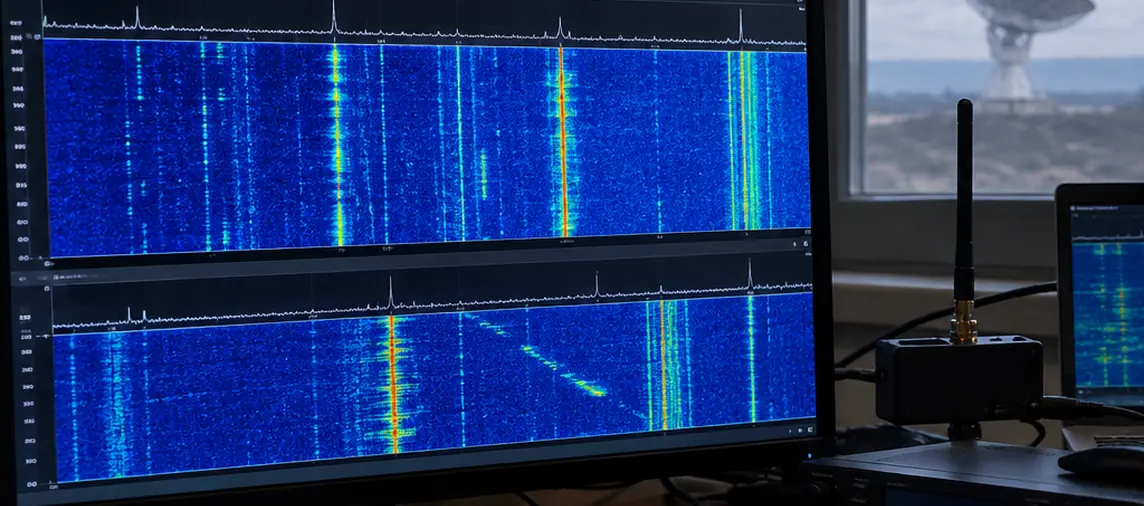
Multi-year amateur RF log reviews indicate that natural ionospheric scintillation frequently mimics physical signal occlusion on single-station readouts. Cross-referencing waterfall dead-zones across geographically separated ground stations can help filter out localized ionospheric scintillation. If an anomalous blackout hits three separate receivers in sequential millisecond order, you are tracking a solid orbital obstruction.
3. N2YO and Stuff in Space: Spotting Telemetry Drops and Graveyard Orbit Staging
Low Earth orbit gets crowded, making high-altitude staging grounds far more attractive for deep-space transit fleets. Researchers pair the WebGL orbital shell rendering of Stuff in Space with the tabular ephemeris logs of N2YO to catch sudden momentum anomalies that visual-only trackers smooth over.
Each platform serves a distinct analytical role when monitoring the supersynchronous graveyard orbit and Lagrange point approaches:
- Stuff in Space: Renders real-time 3D WebGL visualizations of orbital shells, allowing you to spot unexplained debris clustering and sudden spatial pinch points across entire satellite constellations at a glance.
- N2YO: Provides granular tabular ephemeris logs and customizable trajectory alerts, giving you the exact numerical readouts needed to verify whether a specific object has deviated from its predicted ballistic track.
Focus your combined tracking on objects parked 300 kilometers above the 35,786-kilometer geostationary belt. In this quiet graveyard zone, N2YO tabular logs regularly expose sudden inclination shifts of 0.4 to 1.2 degrees, more or less, occurring between standard 12-hour radar update cycles. Conventional chemical thrusters on decommissioned satellites cannot execute these maneuvers.
SGP4 propagation models desynchronize when localized electromagnetic wake turbulence alters micro-debris drag coefficients between 12-hour radar epochs, causing standard two-line element calculators to misplace the target along its orbital track. When a massive non-terrestrial staging craft transits near the geostationary belt, its field propulsion induces drag spikes on nearby micro-debris, throwing off SGP4 positional predictions by 15 to 40 kilometers within a single 24-hour orbital epoch.
Orbital Wake Tracking Alert
Configure N2YO custom alerts to flag any graveyard-belt object whose apogee or inclination shifts beyond 0.4 degrees between two consecutive 12-hour NORAD radar updates. Immediate visual cross-checking of these coordinates frequently reveals uncataloged traffic moving toward deep-space corridors.
4. The SeeSat-L Visual Observer Network and Flash Periodicity Analysis
Mainstream databases scrub anomalous records without warning. Following the abrupt shutdown of the CalSky calculation engine in late 2020, independent trackers migrated their precision flash-timing methodologies directly into the plain-text SeeSat-L mailing list archives to preserve unredacted sightings. This decentralized visual observer network holds decades of raw positional logs detailing classified defense assets and unidentified orbital platforms.
Veteran observers on SeeSat-L rely on flash periodicity analysis to map the physical structure of dark objects during terminator transitions. By logging specular reflections using the Interactive Optical Detections (IOD) format, analysts measure solar glint intervals to tolerances of 10 milliseconds, give or take. A cylindrical satellite bus rotating on its axis produces a predictable, rhythmic flash pattern. When IOD logs reveal non-repeating, sharp-edged millisecond flash intervals, the reflection geometry points toward flat, faceted surfaces typical of triangular flight platforms.
Field verification demands strict methodological discipline. Single-observer flash logs collected within 10 degrees of the geostationary belt cannot reliably separate triangular hull facet glints from routine specular reflections off drifting high-altitude cirrus ice crystals or standard solar array slewing maneuvers. To build certified exopolitical evidence, you must establish dual-station parallax photography using a minimum 35-kilometer ground separation, with both camera shutters synchronized via GPS time-stamping to within 5 milliseconds.
5. KiwiSDR Wideband Receivers for Ionospheric Wake Detection
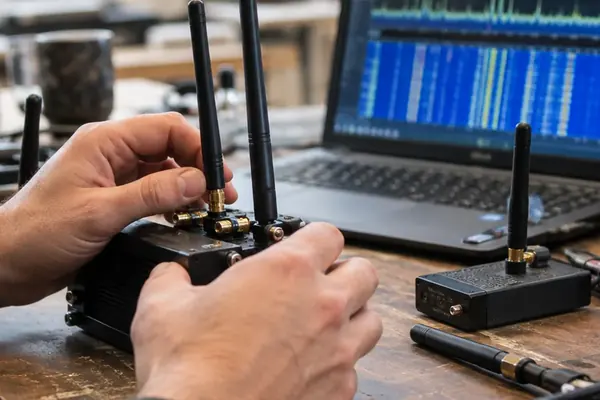
Advanced hulls operating near Earth often deploy both optical light-bending canopies and complete passive RF silence. To defeat these countermeasures, investigators establish a continuous bi-static radar watch using publicly accessible European software-defined radio (KiwiSDR) nodes tuned to military space surveillance transmitters.
Plasma stealth and optical bending technologies still leave an unmistakable thermal and ionized trail when entering the upper atmosphere. You can hear this ionized wake in real time by tuning a web-based KiwiSDR node located in Western Europe to 143.050 MHz in Upper Sideband (USB) mode. This frequency captures continuous-wave scatter bouncing off the French GRAVES radar array. When a massive plasma-sheathed hull disturbs the E-layer ionosphere at 90 to 150 kilometers altitude, the reflected VHF wave registers on the KiwiSDR waterfall as a Doppler whistle spanning something like 400 Hz to 1.8 kHz.
Be aware of the physical floor of this technique. Bi-static meteor scatter detection on 143.050 MHz loses vertical resolution once a descending craft drops below the 85-kilometer D-region ionosphere floor, where rapid atmospheric recombination masks the ionized wake signature from distant KiwiSDR receivers.
Serious investigators must immediately abandon passive reliance on delayed public space agency video feeds. Build an independent dual-verification rig today: pair a local or web-routed KiwiSDR waterfall feed tuned to 143.050 MHz with an automated Sony IMX290-based All-Sky optical camera running continuous 3-second exposures. Combining real-time VHF radar scatter with wide-angle optical skywatching is the only optimal way to capture undeniable proof of orbital staging grounds above our heads.