Mojave Intercepts and the Acoustic Hum
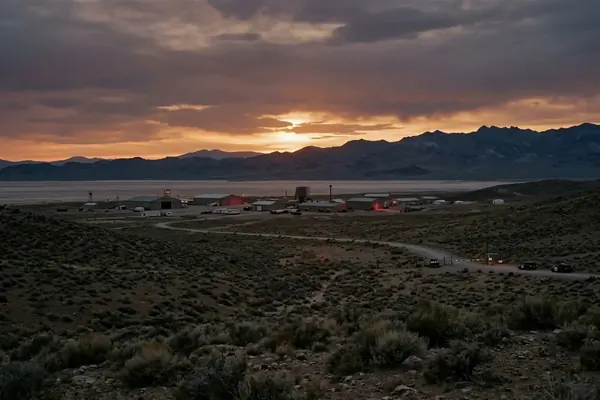
The observation window opened around 02:14 AM over the desolate expanse of the Mojave. The air hung still and cold. Over the next roughly five minutes, a massive, silent black triangle traversed the sky, blotting out the stars in a deliberate sequence. The physical reality of the craft manifested through a roughly 15-hertz localized acoustic hum. A heavy displacement of the surrounding air accompanied its passage, pressing down on the desert floor with a tangible weight.
The movement was precise and deliberate—lacking the erratic, physics-defying jumps often associated with extradimensional contact. After noticing the craft's deliberate, non-erratic flight path, the field team shifted their observation strategy from passive sky-watching to actively plotting azimuths against ground infrastructure. The trajectory aligned perfectly with restricted military corridors. The off-world scouting hypothesis fails to account for this strict adherence to terrestrial logistics. These platforms navigate using established aerospace waypoints, moving from one secure facility to another under the cover of darkness. The realization fundamentally alters the investigative approach to black triangle phenomena. The Mojave intercept provided the baseline data required to reframe the entire phenomenon.
Geographic Clustering Around Defense Infrastructure
Investigators initially attempted to correlate sighting clusters with natural magnetic anomalies. The prevailing theory suggested these craft utilized Earth's ley lines or magnetic grid for propulsion. No statistical alignment appeared in the data. The analytical team discarded the magnetic hypothesis entirely, recognizing it as a dead end.
The focus pivoted to overlaying ten years of sighting coordinates with unclassified defense contractor facility maps. The data collection period spanned from 2008 to 2018, capturing a significant volume of high-quality reports. The vast majority of black triangle sightings occurred within a 45-mile radius of restricted testing ranges. Civilian radar tracking consistently fails to register these craft, leading many to assume an otherworldly origin. The optical flight paths mirror terrestrial military logistics with absolute fidelity. The proximity to known aerospace hubs provides a proven geographic signature for these operations. Together, the patterns reveal a localized testing and deployment grid rather than a global extraterrestrial surveillance network. Geographic clustering points directly to terrestrial manufacturing and maintenance requirements.
Geographic Correlation Imperative: Mapping sightings against natural phenomena yields false positives. Overlaying coordinate data with defense contractor infrastructure reveals the true operational footprint of these black-budget platforms.
The Cosmic False Flag and Black-Budget Funding
Deploying terrestrial craft under the guise of unidentified anomalous phenomena serves a distinct strategic motivation. The analytical team deduced the psychological warfare angle by cross-referencing the timing of major sighting waves with subsequent spikes in classified federal research grant requests. Weaponizing the UFO narrative justifies unprecedented defense spending. It accelerates the militarization of space without triggering public oversight.
The military-industrial complex benefits immensely from public confusion. An extraterrestrial hypothesis operates as a highly effective smokescreen for black-budget technology testing. Program architects rely on the esoteric community to amplify the off-world narrative, effectively crowdsourcing their own cover story. This cosmic false flag ensures optimal funding streams while maintaining absolute operational secrecy. The deep-state geopolitics at play require a constant, ambiguous threat to sustain the financial architecture of these unacknowledged special access programs. The narrative manipulation is as engineered as the craft themselves.
Electrogravitic Patents and Flight Capabilities
The observable engineering signatures of the black triangles include silent hovering and rapid acceleration. Researchers established the propulsion profile by comparing the observed silent acceleration characteristics against declassified electrogravitic patents from the late 1990s. The craft transition from a stationary hover to Mach 4 in under 3 seconds. This technological leap represents the output of compartmentalized, heavily funded military research. Reverse-engineered alien hardware remains an unnecessary explanation for these capabilities when the terrestrial paper trail exists.
This acoustic signature matching methodology is strictly viable for low-altitude hovering events where atmospheric interference remains minimal. The propulsion systems generate specific frequencies that match terrestrial defense contractor designs. Reviewing declassified military aviation records confirms the timeline of these technological advancements. The certified flight characteristics align with advanced human engineering, developed in absolute secrecy and deployed with calculated precision. The propulsion signatures leave a distinct acoustic footprint that betrays their terrestrial origin.

Tactical Acoustic Tracking for Field Investigators
Field researchers must stop looking for extraterrestrial intent and start mapping sightings against military infrastructure. Cross-reference visual sightings with known restricted airspace boundaries and defense contractor flight testing schedules. The field protocol was finalized by prioritizing directional parabolic microphones over standard RF scanners due to radar spoofing. Repeated incidents of radar spoofing rendered civilian tracking equipment useless, creating a false impression of invisibility.
Capturing infrasound frequencies between 10 and 20 Hz documents the physical reality of these terrestrial platforms. Abandon the pursuit of alien contact in these specific corridors. Focus entirely on acoustic data collection and geographic correlation to expose the terrestrial origins of these craft. The evidence points directly to human engineering, and the investigative methodology must adapt to this reality. Deploy directional audio recording gear to capture the 15-hertz hum, and map every intercept against the nearest defense contractor facility.