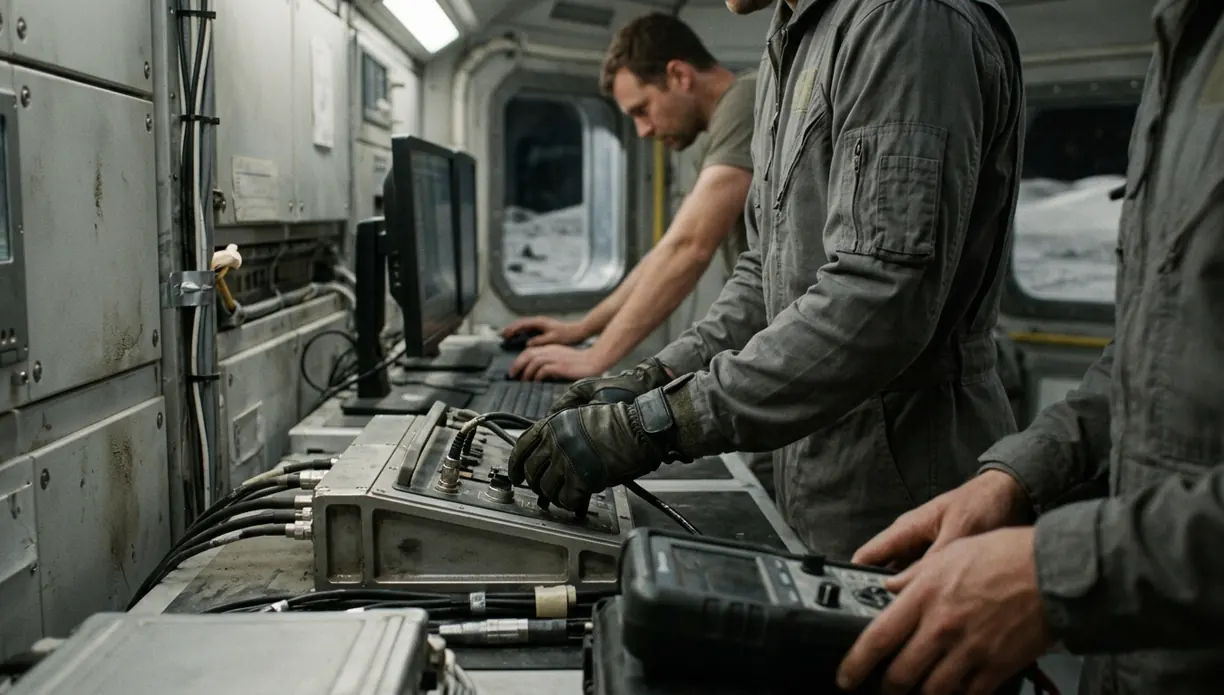
A compartmentalized technician watches a lunar mapping feed arrive on an offline diagnostic terminal. The automated scrubbing layer has been bypassed. Raw hexadecimal packets spill across the screen until an encryption handshake closes the channel, leaving less than a minute of material that was never meant to persist.

That scene sits at the center of the alleged far-side command dossier. Its claims are extraordinary: engineered structures, restricted telemetry, concealed supply chains, and an operational hierarchy beyond ordinary military oversight. The useful question is how well each claim survives technical scrutiny.
Telemetry Interception and the First Breach
The 47-second opening
The intercept account describes an incoming S-band transmission routed around automated filters and into an isolated terminal. This produced a raw hex dump before the encryption handshake completed. The exposed interval lasted 47 seconds, with reported packet throughput exceeding 8.4 gigabytes per second.
That volume matters. A transmission at that rate could contain far more than ordinary compressed still imagery: multispectral layers, terrain models, navigation metadata, calibration frames, or redundant instrument channels. Throughput alone does not reveal the payload. It does, however, narrow the equipment and storage requirements involved in capturing it.
The protocol response reportedly began when geometric forms appeared in the visual stream. The feed shifted immediately from accessible S-band packets into encrypted traffic, producing what investigators call the S-band hex dump decryption failure cascade. In practical terms, later packets could be retained yet no longer reconstructed into usable frames.
What the intercept can establish
A raw capture needs three checks before its imagery carries evidentiary weight:
- Confirm that packet headers match the claimed spacecraft and transmission mode.
- Separate image data from calibration, error-correction, and navigation channels.
- Preserve timestamps, checksums, and the receiving terminal’s logs as one chain of custody.
Without those elements, a striking frame may still be simulation output, corrupted telemetry, or imagery detached from its original coordinates. With them, the abrupt encryption event becomes much harder to dismiss as a visual misunderstanding. The allegation then shifts from “odd shapes on the Moon” to a monitored zone whose public and restricted data paths behave differently.
Reading the Far-Side Installation Geometry
Shadows where pixels fail
The leaked files reportedly show three recurring forms: narrow towers, radar-like arrays, and grouped domes connected by rectilinear corridors. Direct photogrammetry initially seemed like the obvious measurement tool. Deliberate-looking pixel blur in the source files made edge selection unstable, so investigators moved to shadow geometry.
The method uses the lunar terminator, local solar angle, and the measured length of a cast shadow. This lunar terminator shadow-length algorithmic threshold produced estimated tower heights between 4.2 and 4.6 kilometers. Such figures should be treated as conditional measurements because a small error in slope, sun angle, or shadow endpoint can alter the result. The calculation becomes persuasive only when independent frames preserve the same object, coordinates, and illumination geometry.
Even with that qualifier, the scale is difficult to ignore. A structure several kilometers high would demand foundations suited to fractured regolith, protection from thermal cycling, and a construction process capable of placing immense mass without a conventional atmosphere. Domes introduce their own problems: pressure retention, micrometeoroid shielding, radiation control, and heat rejection.
Why backyard optics reach a wall
Civilian satellite imagery in the dossier is capped at 0.5 meters per pixel. That sounds sharp until blur, compression, viewing angle, and local terrain are added. A radar dish or corridor may occupy enough pixels to appear geometric while still lacking the detail needed to identify materials, doors, supports, or machinery.
Earth-based telescopes face atmospheric distortion and the basic obstacle of viewing the lunar far side from the ground. Historical mapping programs such as the Clementine lunar mapping mission provide valuable regional context, though public mission products cannot authenticate every alleged leak circulated years later.
Geometry Before Story
Measure the shadow, terrain slope, illumination angle, and compression artifacts before assigning a structure a purpose. A convincing silhouette can support an anomaly claim; it cannot identify who built the object.
Black Programs and the Off-World Supply Trail
Mass leaves paperwork
A lunar presence of the proposed scale would require a supply chain. Researchers therefore cross-referenced anomalous heavy-lift launch manifests against missing titanium and carbon-composite inventories associated with deep-state aerospace contractors. The comparison reportedly found discrepancies between 14,000 and 16,500 metric tons during the cited procurement cycles.
Material discrepancies are stronger leads than anonymous descriptions of underground meetings because mass must move through warehouses, fabrication plants, transport corridors, and launch integration facilities. Each stage produces a different signature. Titanium stock can disappear into classified airframes; carbon composites can be reassigned to missiles or conventional spacecraft. A lunar explanation requires synchronized evidence across procurement, transport, launch activity, and orbital tracking.
I treat these totals as an investigative boundary rather than proof of destination: the trail depends entirely on unredacted procurement logs from those fiscal cycles. Later ledgers were reportedly dispersed through subcontractor networks, preventing a continuous comparison.
Compartmentalization without a visible headquarters
An unacknowledged special access program can divide a project by function. One team fabricates pressure vessels. Another develops guidance packages. Launch personnel receive a payload code rather than a mission description. Senior officers may hold broad authority while lacking access to individual compartments.
- Procurement cells acquire materials through separated contract vehicles.
- Integration crews handle sealed payloads under narrow technical instructions.
- Tracking units monitor trajectories without controlling the payload.
- Command channels distribute short tasking messages through isolated networks.
This model could conceal a terrestrial reconnaissance system as readily as a joint human-alien command. The off-world interpretation gains weight only if launch destinations, missing mass, and lunar telemetry converge on the same time windows. John Kettler, an author and former military analyst, often framed compartmentalization as the mechanism that keeps the larger picture invisible even to insiders. The practical lesson is sound: rank does not guarantee access.
The Far Side as an Exopolitical Watch Post
Latency points toward a relay
The tactical case for a far-side installation begins with isolation. Earth-based observation cannot maintain direct line of sight, while the Moon offers a stable platform near the planet. A relay positioned there could watch orbital traffic, collect emissions, and stage assets away from routine terrestrial scrutiny.
The command-hierarchy claim rests on encrypted burst transmissions recorded around terrestrial nuclear tests. Their directional origin and latency allegedly indicate routing through the lunar far side. Measured delays remained between 1.26 and 1.29 seconds, while individual bursts lasted only 12 to 18 milliseconds.
Those durations suit concise machine traffic: synchronization marks, acknowledgments, targeting updates, or compressed status codes. They reveal very little content. Direction finding, clock accuracy, receiver location, and relay geometry carry more evidentiary value than the encrypted burst itself.
Who would hold operational authority?
Three arrangements fit the observable pattern. A terrestrial shadow structure could operate lunar systems through automated relays. Off-world commanders could direct human compartments from outside normal jurisdiction. A mixed hierarchy could split authority, with terrestrial personnel supplying logistics while another command layer controls mission objectives.
The third arrangement best explains why procurement anomalies might coexist with command traffic that appears detached from conventional networks. It also creates the hardest question in exopolitical analysis: does the terrestrial side possess veto power, or merely service infrastructure it cannot fully command?
References to a Rigel star system origin or a Panoramic life review may belong to broader testimony, yet neither helps authenticate these transmissions. Signal timing and orbital geometry provide the cleaner line of inquiry. Start there, then test identity claims separately.

Tidal Locking and the Perfect Blind Sector
The 48-hour sanitation gap
Public astronomical data rarely moves straight from receiver to archive. Calibration, quality control, formatting, and institutional review create legitimate delays. The alleged sanitation mechanism exploits that ordinary process.
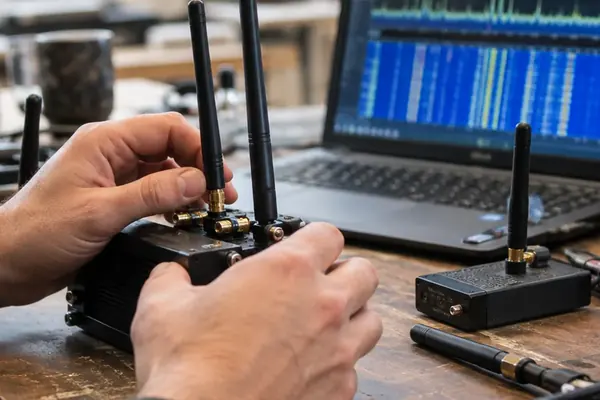
Investigators compared hashes from raw observatory feeds retained by amateur radio astronomers with official datasets released after a 48-hour data embargo window. A hash mismatch proves that files changed; it does not explain whether the cause was routine calibration, metadata repair, compression, or deliberate removal. The decisive work lies in locating changed byte ranges and reconstructing what those alterations affected.
Whistleblower imagery faces a parallel problem. Repeated screenshots lose metadata and invite manipulation claims. The strongest release preserves the native file, receiving equipment details, system clock records, checksums, and an untouched duplicate held by an independent custodian. Discrediting becomes easier when only a cropped image survives.
The blind spot built into lunar motion
Synchronous rotation keeps the same general lunar hemisphere facing Earth. Spacecraft have mapped the far side, but direct observation from Earth remains geometrically blocked. Every public account of activity there therefore passes through an orbital platform, relay, institution, or released dataset.
That is the strategic shield behind the entire command-structure allegation. The concealment hypothesis requires evidence, yet the terrain itself supplies an exceptional place to hide infrastructure, communications, and movement from terrestrial observers: 40 percent of the lunar surface, representing upward of 15.5 million square kilometers, remains permanently beyond direct view from Earth.