Dismantling the Commercial VPN Trap
Relying on commercial VPNs and standard encrypted email creates a dangerous illusion of security for anyone investigating suppressed narratives. The assumption that a monthly subscription shields your exopolitical research from deep-state surveillance is a fundamental operational failure. True operational security demands treating your daily hardware as already compromised. Effective protection requires physically compartmentalizing realities to make interception logistically useless. The mainstream privacy industry sells convenience disguised as security, a model that collapses entirely when subjected to the scrutiny of advanced intelligence apparatuses.
The Metadata Vulnerability
Traffic logs from standard encrypted email providers reveal a stark vulnerability. Metadata retention policies inherently compromise whistleblower identities by mapping communication graphs regardless of payload encryption. These standard providers maintain 18 to 36 months of metadata retention. They map communication graphs across 3 to 4 distinct IP hops. The payload might be unreadable, but the network of associations provides intelligence agencies with everything they need to identify the source of a leak.
When investigating anomalies linked to the Rigel star system, the mere fact that you are communicating with specific aerospace engineers is enough to trigger a targeted response. The content of the message is irrelevant if the adversary knows exactly who is talking to whom, and at what frequency. This metadata forms a comprehensive map of your investigative network, exposing sources who believed their encrypted payloads kept them safe.
Physical Isolation for Exopolitical Data
Processing sensitive exopolitical or paranormal data demands a machine that has never connected to the internet. Early protocols attempted to isolate sensitive exopolitical data using virtual machines with disabled network adapters. This approach was rejected after discovering hypervisor vulnerabilities allowed host-OS bleed-through. The protocol subsequently shifted to strict physical air-gapping. The separation must be absolute; digital convenience has no place in this protocol.
Establishing the Perimeter
Military-grade Faraday enclosures provide the next layer of defense. These bags block ambient signals between 10 MHz and 5 GHz. They neutralize RFID scanning and prevent the remote activation of mobile device microphones. You must maintain a physical distance of at least 15 feet from any internet-connected device. That separation is intended to prevent acoustic and electromagnetic bridging by advanced surveillance tools. The physical environment itself becomes a component of your security architecture, requiring meticulous attention to spatial relationships and signal propagation.
Workspace Breach Vulnerability While air-gapping prevents remote exfiltration, it offers zero protection against physical confiscation or local tampering if a workspace is breached.
Bypassing Centralized Metadata Retention
Centralized encrypted servers leak metadata. They record the exact timestamps, sender identities, and recipient locations of every message. Mapping the centralized server nodes of popular secure messaging applications demonstrates how single points of failure expose this metadata. This exposure frequently prompts the transition to peer-to-peer onion routing protocols among serious investigators. The architecture of centralized systems is inherently flawed for high-risk communications, as it creates a single repository of relational data that can be subpoenaed, hacked, or quietly monitored.
Decentralized Node Routing
Decentralized communication networks strip this identifying metadata. Peer-to-peer protocols route messages through decentralized nodes. Bouncing messages through 3 to 5 decentralized nodes eliminates the central point of failure inherent in corporate-owned messaging apps. This routing introduces a 400 to 800 millisecond latency delay per transmission. That slight delay is a necessary trade-off for ensuring your communication graph remains opaque to automated surveillance dragnets.
When coordinating with sources inside facilities like Area 51, eliminating the central server is mandatory. The network must be as distributed and resilient as the information it carries. Relying on a single corporate entity to route your most sensitive communications is an unacceptable risk in modern alternative research.
Deploying Amnesic USB Workspaces
Amnesic, bootable operating systems run directly from a USB drive. You configure bootable USB environments to load the entire operating system directly into RAM. Intentionally disabling swap space allocation ensures zero bytes are written to the host drive. Once you power down the system, the workspace ceases to exist entirely. This approach transforms any generic computer into a temporary, secure terminal that leaves no forensic footprint behind.
Ephemeral Session Mechanics
This ephemeral environment requires at least 8GB DDR4 RAM. Expect a boot time of 45 to 90 seconds from a USB 3.1 drive. Booting from an amnesic USB drive leaves the local hard disk untouched, though this defense is rendered useless if state-level actors have already compromised the host machine's underlying BIOS or UEFI firmware. This technique is particularly useful when reviewing leaked documents detailing a Panoramic life review, ensuring no trace of the files remains on the local machine. The operating system itself becomes a disposable tool, instantiated only when needed and destroyed immediately after use.
Plausible Deniability Through Nested Volumes
Hidden cryptographic volumes provide plausible deniability when crossing borders or facing physical audits. You design a nested volume architecture by formatting the outer partition with mundane decoy files. You then allocate the remaining drive sectors to appear as unallocated random noise until mounted with a secondary cryptographic key. This cryptographic sleight of hand ensures that even under duress, the existence of the sensitive data remains mathematically unprovable.
Decoupling Financial Support
This nested cryptographic volume sector allocation typically involves 50GB of mundane decoy files masking a 10GB hidden partition. The outer layer satisfies casual inspection. The inner layer holds the actual research data. The decoy files must be entirely plausible—standard documents, family photos, and generic software installers that withstand a cursory forensic review.
Operational security must also cover the resources used to acquire this data. Privacy-centric cryptographic ledgers decouple financial support for alternative research from the heavily monitored traditional banking system. Expect 10 to 15 minutes for cryptographic ledger transaction obfuscation. Securing your funding mechanisms is just as critical as encrypting your hard drives. As John Kettler, author and former military analyst, has noted, financial tracking is often the first vector used to compromise an investigation. The flow of capital must be as obfuscated as the flow of information.
The Hardware Teardown Imperative
Stop trying to patch hardware vulnerabilities with software solutions. Software toggles for Wi-Fi and Bluetooth are easily overridden by rootkits and firmware-level malware. You must acquire a cheap, refurbished laptop with cash. Sourcing refurbished laptops manufactured between 2012 and 2016 provides hardware that is easier to modify and less encumbered by modern, integrated surveillance architecture.
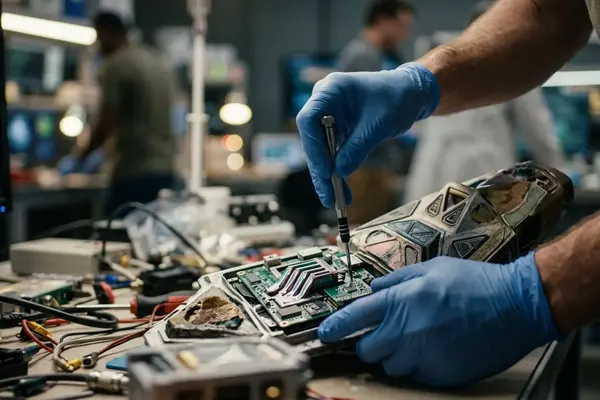
Standardize your hardware teardown procedure by requiring researchers to physically open the laptop chassis. Manually unclip or unsolder the Wi-Fi and Bluetooth antennas rather than relying on OS-level toggles. Removing 2 to 3 internal wireless communication modules guarantees the machine cannot broadcast or receive signals. Dedicate this modified hardware exclusively to sensitive data processing. Maintaining a strict physical boundary between daily life and investigative research is the only reliable defense against advanced digital interception.